For this week's blog, I chose chapter 17 which talked about fallacies of argument. According to the book, fallacies are arguments that are flawed by their very nature or structure. In other words, they may make sense initially, but after taking a step back and analyzing the argument it may not be accurate or valid. The chapter discussed three general types of fallacies: fallacies of emotional argument, fallacies of logical argument and fallacies of ethical argument. For each of these three types, there were more specific types of fallacies which the book discussed. For example, fallacies of emotional argument include scare tactics; fallacies of ethical argument include Ad Hominem arguments and fallacies of logical argument include hasty generalization. Obviously, there are additional specific types, but this is just an overview.
A section in the chapter that I thought was particularly interesting was the one which discussed fallacies of emotional argument. I am very used to seeing all of these fallacies in the media and politics. The only problem previously was that I didn't know the correct terms to describe the fallacies. Anyway, while I was reading, I thought of different examples in everyday life that related to each fallacy. Additionally, the examples that the authors added in their own examples. These two factors made this section easy to understand. The authors did a great job of incorporating examples to enhance comprehension.
Fallacies of argument are rampant in election campaigns and pretty much politics in general. I could present many examples, but I will save everyone the hassle and just stick to one. Back when the U.S. invaded Iraq, they did so with the notion that Saddam Hussein possessed nuclear weapons. Before declaring war, people in the government were insistent that he had the weapons and that he could use them at will. This kind of information lead to widespread support among the American public for military action in Iraq. Now, we know understand that Saddam never had nuclear weapons. Perhaps the intelligence gathered that supported this idea of Iraq having nuclear was inaccurate and faulty. Regardless of the accuracy, this type of rhetoric could be seen as a sort of scare tactic to garner support for war. Yes, perhaps back then the information may have been seen as credible, but seeing now that it wasn't, those statements could be seen as scare tactics.
Monday, March 26, 2012

Sunday, March 4, 2012
Chapter 13: Style in Arguments
Chapter 13 dealt with the subject of an author's style and how it can enhance an argument. There are apparently three different styles that can be utilized in argument: high (formal), middle (understated and very clear) and low (everyday or humorous). According to the book, style in argument can be conveyed through word choice, sentence structure, punctuation and "special effects." To demonstrate, the book gives an example on how style and word choice are related. The example talks about Chevron CEO Dave O'Reilly and how he "adopts a formal and serious tone" in addressing an important audience on the future of energy (Lunsford 418). If he were to use a more informal tone, his statements would not garner much attention or be taken seriously. From this example, it's evident that word choice can go far in distinguishing a person's style and ultimately a person's argument. The rest of the chapter just discussed how sentence structure, punctuation and "special effects" form the style of an argument.


The section that was interesting to me in this chapter was the section on Figurative Language and Argument. First off, I was initially curious about the term "special effects" used earlier on in the chapter. I had previously only heard of movies containing special effects, until this section of the chapter referred to figurative language as the special effects of an argument. In a way, it is pretty accurate. Special effects make movies more interesting and intriguing while figurative language does the same for writing. This section also made me think about how prevalent figurative speech really is in today's English language. This was prompted by the author listing many widely-used phrases that qualify as figurative speech.
Although this chapter talks distinctly about style in arguments, It made me think of styles that people try to "rock." I'm not big on fashion or anything, especially, considering I can't tell what makes something fashionable and such. In addition, I immensely dislike shopping for new clothes. Irregardless of my fashion sense, I still observe the different people around me and the way they dress and embrace styles. The example about the Chevron CEO and his formality in his address reminded me of people dressing for formal occasions. For example, you wouldn't want to show up to an important interview sporting a Mohawk and jeans. This dress style wouldn't be suitable for this particular occasion, the same way using slang wouldn't be appropriate in the Chevron CEO's address. In this situation of an interview, the proper style would be professional business attire. Style can make or break an argument, so it is key to identify the the most appropriate style for your argument.
Sunday, February 19, 2012
Chapter 9: Arguments of Definition
Chapter 9 focused on arguments of definition and discussed how terms with many definitions or no clear definition can lead to confusion and dissonance. For example, the book brings to the mind the controversy over how to define human intelligence. According to the book, some would define human intelligence as related to performance on IQ and SAT tests. Others see it as the ability to perform specific practical tasks. Additionally, there are even those who define human intelligence as a competence in relating to other people. From this example, it is obvious to see that for many terms there is no simple all-encompassing definition. The chapter goes over several different topics such as the kinds of definition, how to develop a definitional argument, and the key features of definitional arguments. Towards the end of the chapter, there is also a guide on how to write an argument of definition.
An interesting section in chapter 9 is the section on the kinds of definition. I had never thought that deeply about there being different types of definitions. I always thought of definitions as those in the Webster's Dicitionary, so it was interesting gain the insight of there being multiple types of definitions. I thought that the authors did a pretty solid job at describing the types of definitions and providing meaningful examples.
This whole discussion of terms having many definitions can actually relate to my musical taste. I am a fan of techno/electronica music, but not necessarily every sub-genre. Generally, it is presumed that this kind of music is just created from a bunch of robot noises and does not include any vocals. This is generally the definition associated with this type of music. It's not an exact definition, but it's the definition my friends associate with it. Yes, some genres and sub-genres of electronica music do include music that lies within that definition. For me though, the music I listen to generally has softer sounds and more vocals. Therefore, my definition of this type of music varies from the definition given by my friends or other people. This just goes to show how many terms can have a variety of definitions.

An interesting section in chapter 9 is the section on the kinds of definition. I had never thought that deeply about there being different types of definitions. I always thought of definitions as those in the Webster's Dicitionary, so it was interesting gain the insight of there being multiple types of definitions. I thought that the authors did a pretty solid job at describing the types of definitions and providing meaningful examples.
This whole discussion of terms having many definitions can actually relate to my musical taste. I am a fan of techno/electronica music, but not necessarily every sub-genre. Generally, it is presumed that this kind of music is just created from a bunch of robot noises and does not include any vocals. This is generally the definition associated with this type of music. It's not an exact definition, but it's the definition my friends associate with it. Yes, some genres and sub-genres of electronica music do include music that lies within that definition. For me though, the music I listen to generally has softer sounds and more vocals. Therefore, my definition of this type of music varies from the definition given by my friends or other people. This just goes to show how many terms can have a variety of definitions.
Sunday, January 29, 2012
Arguments Based On Emotion: Pathos
Chapter 2 from the "Everything's An Argument" text discusses the use of pathos in visual arguments. Pathos is used in visual and written arguments to play on people's emotions to get them to feel or react a certain way about a cause. Pathos can be used in several ways to be effective. Much like Ethos, it can be a way to create a bridge between you and the reader of your material. Instead of relying on just your position or experience, as is the case with Ethos, Pathos uses an emotion appeal to draw in the audience. It's not to say that pathos doesn't use past experiences. The difference is based on the fact that pathos concentrates specifically on the emotional aspects of past experiences, rather than just on the general experience. In the text, there is an excerpt from a commencement speech given by Apple's Steve Jobs. In this speech, Jobs notably uses three stories from his life to prepare his audience to accept advice he'll give later on in his speech. For example, this particular excerpt talks about how he [Jobs] co-founded Apple only to get fired from the company later on. He used the time after his firing to take on new ventures and was fairly successful. Considering the title of the speech is "You've Got to Find What You Love, Jobs says," this story is an effective emotional appeal used drive home his point. Here is an example of a visual argument that effectively uses Pathos:

The purpose of this advertisement is obviously to convince or help individuals quit smoking. This is evident as it is written on the bottom portion of the poster. Looking at the big picture, these words are of less importance to ad than the words in the top half of the advertisement along with the image of a former smoker. The combination of the image of the man and his quote is what makes this ad effective. Regardless of whether you first read the quote or look at the man with his speaking aid, the combination of the two causes both smokers and non-smokers to sympathize for the him. For smokers the appeal is much stronger. Some may be convinced to reflect on their habit based on the fear that arises when imagining ending up like the man in the ad. The eventual hope for the creators of this advertisement is that fear will cause smokers to call 311 and inquire about how to quit.
Friday, January 27, 2012
WP1 Topic Ideas
So far I have only been considering general topics--I do not have a specific ad in mind. My ad will most likely come from one of these categories:
War/Conflict
Violence
Consumerism/Marketing Tactics
Discrimination
Drugs
Education
Poverty in America or abroad
War/Conflict
Violence
Consumerism/Marketing Tactics
Discrimination
Drugs
Education
Poverty in America or abroad
Monday, January 23, 2012
Visual Arguments
This reading discussed the power of visual arguments and how they can affect people's perception, emotions, feelings, reasoning. The reading talked about various forms of visual arguments such as images, statues, logos, television etc. In particular I'd like to focus on logos/images. Logos can leave a mark on the eyes of the beholder. For example, think of a Mercedes-Benz or McDonald's logo. The Mercedes-Benz logo is pretty much a three-pointed star with a circle around it, but it garners much respect. People see it as a symbol indicating a person's high status. The McDonald's logo is also fairly basic; it is made of two yellow arches known as the "golden arches." People see the logo and quickly recognize that it stands for McDonald's. These examples also hold for Jeep, Coke many other universal brands. It just goes to show that something as simple as the Mercedes-Benz logo can affect a person's logic. If you were to take the logos off of all the cars on the road, one could argue that some less expensive cars look just as nice as some luxury cars which people will pay a hefty amount for. The logo and name is what may set something such as a Benz apart from other cars. Another sort of logo or image that arguably left a large mark was this portrayal of President Barack Obama:
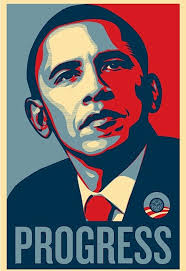
In the 2008 general election cycle, this portrayal was distributed via T-Shirts, pamphlets, the internet, etc. People even put their own faces on this image through programs that allowed them to do so. In this particular photo, the word "Progress" is labeled on the bottom. In another variation of this image, the word "hope" is written on the bottom. You can see how this image would appeal to some voters. First off, it has patriotic colors. Secondly, Obama's face makes him look determined which corresponds with words such as "hope" and "progress." Lastly, there is an "O" on his suit which is there to remind the audience of his last name. Regardless of political affiliation, this is a strong visual argument.
In the 2008 general election cycle, this portrayal was distributed via T-Shirts, pamphlets, the internet, etc. People even put their own faces on this image through programs that allowed them to do so. In this particular photo, the word "Progress" is labeled on the bottom. In another variation of this image, the word "hope" is written on the bottom. You can see how this image would appeal to some voters. First off, it has patriotic colors. Secondly, Obama's face makes him look determined which corresponds with words such as "hope" and "progress." Lastly, there is an "O" on his suit which is there to remind the audience of his last name. Regardless of political affiliation, this is a strong visual argument.
Tuesday, January 17, 2012
An Introduction
Hi, my name is Payam. I realize that the title of this blog has no relevance to English 102, but oh well. Anyway, I am originally from Scottsdale which is pretty much connected to Tempe. I am a Finance major here at ASU and I'm aspiring to double major in another major such as Accounting or Economics. I like poetry readings, long walks on the beach at night, and bird watching. Okay, you got me. In reality, I do like some poetry, the beach, and nature. In addition, I like reading, sports, and being observant of the world around me. For the sake of brevity, I'll just leave my general interests at that. In terms of music, I try to avoid the over-played songs on the radio these days. I pretty much like everything else except country (I strongly dislike country music). My favorite genres are probably trance and alternative. I said I would stop listing things that interest me, but seeing that I'm having great difficulty reaching the word requirement, I will continue to do so. I enjoy watching movies. My favorite movie genres are comedy, drama and some action adventure movies that actually have a plot (think Inception). I would love to travel the world and fulfill my thirst for learning about other cultures. My goal in life is to pay my dues through school and work, so that I can travel, learn a few languages, read up on subjects that I've always been interested in and enjoy/see some of the finer things in life:
These are just a few of the places and attractions I'd like to travel to and see with my own eyes.
 |
| Random Beach |
| Tuscany, Italy |
| Eiffel Tower- Paris, France |
| Sunset in New Zealand |
| Great Wall of China |
Subscribe to:
Posts (Atom)